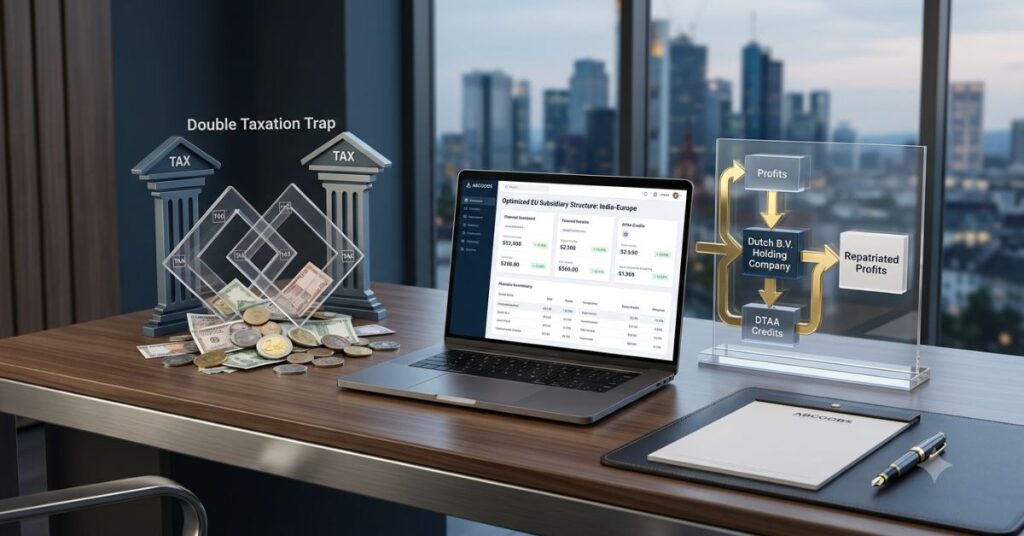
It is incredibly frustrating to generate €2 Million in European revenue, only to see a massive chunk of your profits disappear when you try to bring that money back to India to fund your local operations.
This happens to Indian companies all the time. First, the German tax authority (Finanzamt) taxes the corporate profits made in Europe. Then, when the company transfers the remaining funds back to the Indian parent company, the Indian Income Tax Department steps in and taxes it again as incoming corporate income.
This isn’t just bad luck; it happens when companies treat their new European subsidiary like a simple “local office” instead of setting it up as a proper cross-border entity.
If you want to protect your margins, you have to get your cross-border accounting India Europe right from day one.
The Operational Headaches of Cross-Border Accounting
Managing the books for an Indian company is straightforward. But the moment you add a European branch, the complexity multiplies. Here is where the operational breakdowns usually happen:
- The Transfer Pricing Trap: We see Indian parent companies build software for their German branch for “free.” This is illegal under European Transfer Pricing rules (the Arm’s Length Principle). The German tax office will flag this, demand that you charge a standard market rate for the work, and hit you with penalties for shifting profits.
- Currency Mess: If you invoice in Euros but report in Rupees, the exchange rate changes constantly. If your domestic Indian accountant doesn’t properly record these daily Forex gains and losses, your annual audit in Europe will become a nightmare.
- Different Calendars: Consolidating a European balance sheet (which runs January to December) with an Indian one (April to March) requires staggered accounting that standard software like Tally simply cannot do automatically.
The Operator’s Framework: Setting up a Clean Financial Structure
To survive European tax audits and actually keep the money you earn, you need a clean structural setup. Here is how an unplanned expansion compares to an operator-led financial setup:
| Financial Detail | Unplanned Setup (High Risk) | Operator-Led Structure (Margin Protected) |
| Where to Incorporate | Setting up directly in a high-tax European state without a plan. | The Holding Model: Using a Dutch B.V. as a holding company to use the Netherlands’ very favorable tax exemption laws. |
| Internal Invoicing | Sending random invoices between the India and EU offices. | Clean Transfer Pricing: Using documented studies to charge a standard markup (e.g., Cost + 15%) that passes EU audits. |
| Bringing Profits Home | Paying full tax in both Europe and India. | Using Treaties (DTAA): Getting a Tax Residency Certificate (TRC) to claim tax credits in India for the taxes you already paid in Europe. |
| Daily Bookkeeping | An Indian CA trying to manage European books on standard software. | Local Compliance: Using specialized tools (like DATEV in Germany) to ensure the local tax office gets exactly what they expect. |
Let’s Review Your Cross-Border Setup
European tax authorities are well-funded and very strict. Attempting to manage an EU subsidiary with only domestic accounting experience is a fast way to freeze your corporate bank accounts.
At ABCGOBS, we don’t just advise; we operate. Our financial team bridges the exact gap between Indian compliance and European tax law. We help companies set up the right holding structures, handle the complex transfer pricing documents, and make sure you aren’t paying a single Rupee more in tax than you legally have to.
If you are generating revenue in Europe and want to make sure your financial structure is optimized, let’s get on a call with our cross-border finance operators and review your setup.